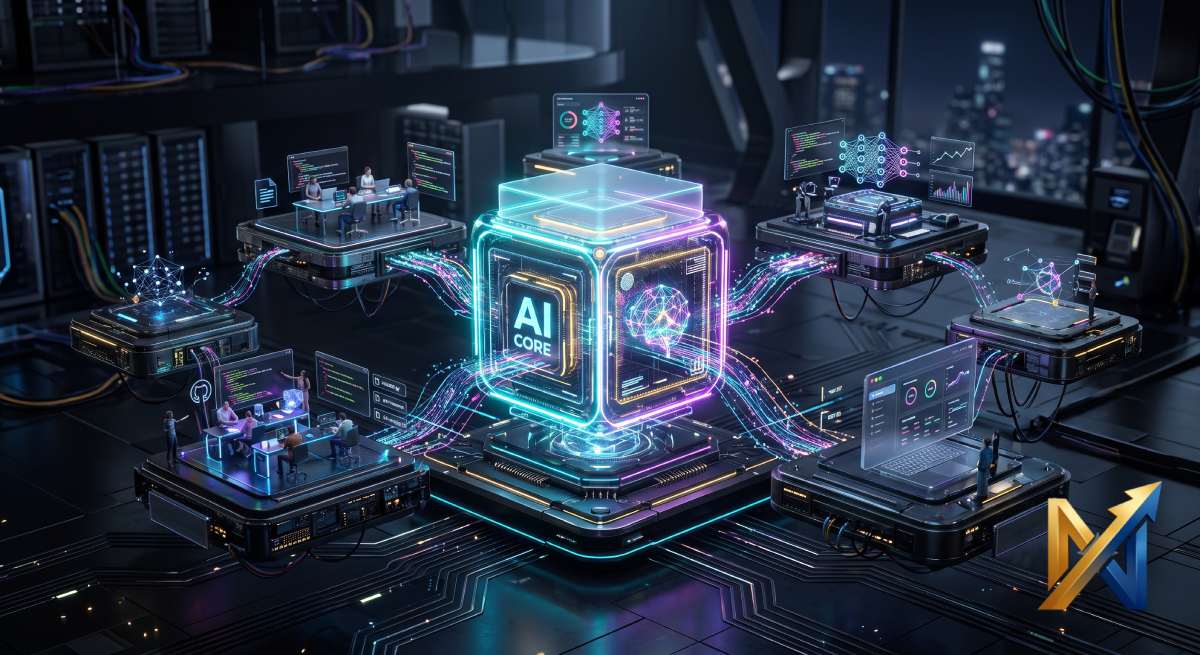
The developer community is entering a completely new era.
A few years ago, developers built passionate communities primarily around programming languages, application frameworks, operating systems, and software tools. Today, many of those critical conversations have decisively shifted toward AI models, AI platforms, and open-source AI ecosystems. The center of gravity in software engineering has relocated, and the global developer community is evolving right alongside it.
🔄 A Historical Precedent of Community-Driven Growth
Every major technology generation has created its own loyal, highly engaged community.
We have witnessed this pattern repeatedly over the decades as platforms matured and massive user bases organically formed around them:
- Design & Operating Systems: We saw the gradual evolution of Adobe Photoshop 6 into the Creative Suite and eventually the Creative Cloud. Similarly, operating systems transitioned from Windows 98 to XP, Windows 7, and all the way to Windows 10 and 11, each bringing a dedicated following of power users and developers.
- Mobile Ecosystems: Android and iOS evolved through multiple generational leaps. Each platform built intensely passionate user and developer bases that collectively defined mobile computing for over a decade.
- Collaboration & Infrastructure: GitHub fundamentally transformed how developers collaborate and share code. Concurrently, tools like Docker and Kubernetes completely reshaped application deployment, moving the industry toward containerized, scalable microservices.
- Web Frameworks: React, Angular, Vue, and other frontend frameworks each developed massive, thriving ecosystems. These communities created plugins, shared best practices, and dictated the industry standards for modern web development.
🚀 The Unprecedented Acceleration of AI Communities
Artificial intelligence is following this exact historical pattern, but at a vastly accelerated pace.
Each new model, platform, or open-source version rapidly develops its own dedicated community of developers, researchers, creators, and enthusiasts. People naturally compare capabilities, share highly optimized prompts, build browser extensions, publish independent benchmarks, create tutorials, and contribute to sprawling open-source projects. Ultimately, these communities become the primary force that accelerates enterprise and consumer adoption.
In 2026, open-source AI ecosystems offer developers an exceptional range of choices, moving far beyond dependency on closed APIs. Developers increasingly prefer open-source models because they provide full control over deployment, improved data privacy, lower operational costs, and offline capability. The community is actively rallying around tools and protocols that make this integration seamless. For instance, the Model Context Protocol (MCP) has been widely adopted in 2026 as a common protocol—essentially the "USB-C for AI"—allowing developers to easily connect AI models to platforms like GitHub, Slack, databases, and local files.
🌐 Open Source Innovation and Model Diversity
The next wave of technological influence will not be driven only by corporate marketing budgets. It will increasingly be shaped by open-source contributions, community-built tools, educational content, independent evaluations, and developers authentically sharing what actually works in real-world production environments.
The 2026 landscape proves that developers prefer having a diverse toolkit. Different workloads require different strengths, meaning there is rarely a single "best" model for every scenario. The open-weight ecosystem is currently thriving with highly specialized families of models:
- Llama 4: Meta's Llama 4 remains one of the most influential open-weight model families, excelling at general-purpose assistants, chatbots, and enterprise applications. This is largely due to its massive community support and excellent fine-tuning ecosystem.
- DeepSeek-R1 and V4: DeepSeek models have become incredibly popular among developers for advanced reasoning tasks, complex problem solving, and agent workflows. Notably, DeepSeek V4 is recognized as the cheapest usable model overall, making always-on summarization and classification pipelines highly cost-effective.
- Qwen 3: Alibaba's Qwen 3 has gained immense popularity due to its excellent multilingual performance, strong language understanding, and long context support. This makes it ideal for international applications and enterprise search solutions.
- Gemma 3 and Phi Series: For lightweight deployments, models like Google's Gemma and Microsoft's Phi series prove that smaller models can deliver highly impressive performance. These are excellent choices for edge devices, mobile applications, and resource-constrained servers.
- GLM-5.2 and Kimi K2.7: In the realm of coding and tool use, models like GLM-5.2 and Kimi K2.7 have emerged as top open-weight contenders. Both of these robust models now rival closed models on real-world tasks.
⚖️ Beyond Raw Technical Performance
The most interesting shift occurring right now is that AI products are no longer judged exclusively by their technical performance or benchmark scores. A few years ago, raw intelligence was the only metric that mattered. Today, the surrounding ecosystem, documentation quality, overall developer experience, platform openness, and community support often become equally important factors in enterprise decision-making.
Developers are no longer just writing isolated code; they are orchestrating multi-agent systems where specialized agents—such as research agents, coding agents, and testing agents—collaborate to complete complex software projects. Because of this complexity, developers rely heavily on platforms like Hugging Face, which has essentially become the GitHub equivalent for AI, providing a centralized repository for models and datasets. Furthermore, developers are actively utilizing platforms like Ollama, vLLM, and Hugging Face Transformers for local and server inference.
💡 The Future is Community-Driven
As developers, users, or AI enthusiasts, this is probably the best time in history to explore different models rather than becoming rigidly attached to just one. Every model has unique strengths, and the most valuable skill in the modern tech industry is understanding exactly where each one performs best.
Technology generations have always been remembered by the communities that grew around them. We remember the early web for its open forums, the mobile era for its vibrant app developer ecosystems, and the cloud era for its massive open-source infrastructure projects.
The AI generation will ultimately be remembered for the global, collaborative communities that helped shape it. By sharing knowledge, building interconnected protocols like MCP, and rigorously testing open-source frameworks, the developer community is ensuring that the future of artificial intelligence remains accessible, transparent, and driven by collective human innovation.