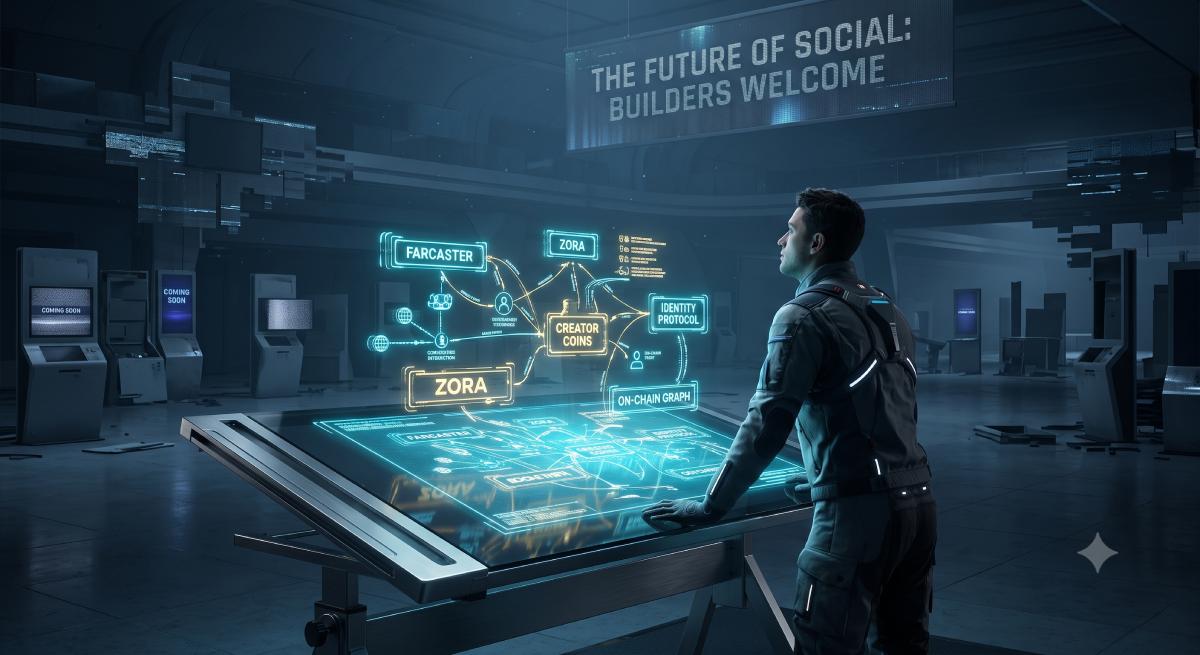
There is a harsh truth currently circulating in the tech ecosystem, summarized by a simple philosophy: "If you cannot create, moderate." Over the last few years, the Web3 space placed a massive, highly capitalized bet on its builders. Betting on the builders was fundamentally the right move, but unfortunately, we directed their immense talent toward the wrong objective: building "decentralized social" networks (SocialFi).
We were promised a new era of social media. The dominant narrative was that the entire market would rapidly transition to decentralized alternatives where users owned their data, their audience, and their monetization. However, the reality of what actually transpired is starkly different. The decentralized social ecosystem—encompassing platforms like DeSo, Farcaster, the Taki app, Zora, and various integrated mini-apps—has been almost completely neglected by organic, mainstream users.
📉 The Farcaster and Zora Reality Check
The industry desperately wanted a Web3 equivalent to traditional social platforms. Farcaster, for instance, was positioned as the blockchain-based social media darling of the current cycle, even reaching a billion-dollar valuation. However, the actual usage metrics paint a rather grim picture. While superficial dashboard readings claimed the platform had 55,000 daily active users, an analysis of the application's API endpoint for active, non-spam "Power Badge" users revealed there were only roughly 4,360 actual daily users. The uncomfortable truth facing builders is that a massive portion of decentralized social activity has been driven by automated bots rather than genuine human interaction.
Prominent industry leaders are now quietly acknowledging this failure. In July 2026, Base founder Jesse Pollak openly admitted that the network's heavy strategic focus on social platforms—specifically citing Farcaster and Zora—was a misstep. As a result, Base has shifted its core strategy away from social applications, pivoting back toward blockchain fundamentals like trading, stablecoin payments, and AI agents.
💸 The Complete Neglect of Social Tokens
The situation is arguably worse for the financial mechanisms built on top of these platforms. The grand vision included creator coins, social tokens, and the ability to tokenize every piece of digital content. Zora, for example, pivoted to an onchain media protocol that pairs Farcaster's social graph with automatic ERC-20 coin minting on the Base network.
Yet, the wider market has thoroughly neglected this heavily financialized social model. The ZORA network token launched in April 2025 and saw its price collapse from an August 2025 peak near $0.15 down to around $0.0065 by July 2026. Other pioneers in the space fared no better; the Friend.tech token traded down approximately 98% from its launch value. Furthermore, Friend.tech's daily active users plummeted 97% from their peak to a meager 230 users, and earlier iterations of SocialFi like BitClout have all but faded into total irrelevance. We attempted to incentivize creators by building speculative price bubbles around them, but when the tokens inevitably crashed, the user base vanished.
⚖️ If You Cannot Create, Moderate
This brings us back to the core lesson of the decentralized social era. The space struggled because it prioritized financial mechanics over actual social connection. Builders were so intensely focused on integrating complex tokenomics, mini-apps, and creator coins that they neglected the user experience that makes social media compelling in the first place.
True mass communication tools require deep curation, healthy moderation, and a relentless focus on content quality—not a built-in micro-liquidity pool for every single post. The next generation of builders must realize that if you cannot naturally create a vibrant, engaging social community from scratch, you must moderate and curate the space to foster one. Forcing a financial token into an empty room does not create a new-era social network; it merely creates an abandoned marketplace.