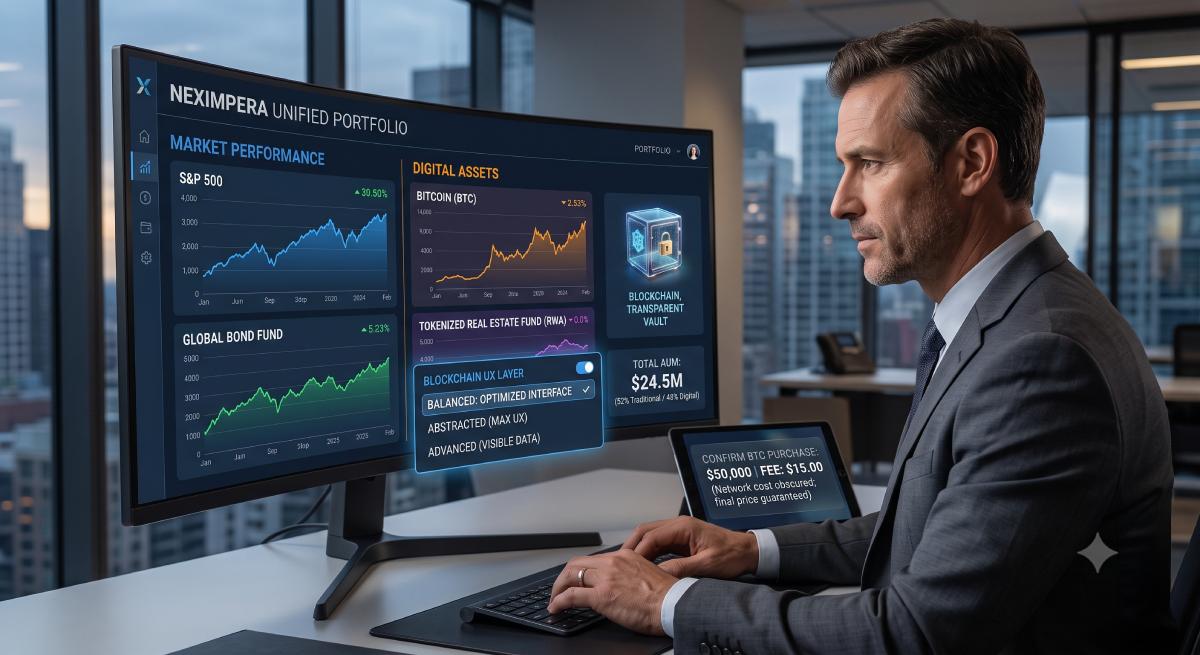
There is a prevailing narrative within the FinTech and Web3 communities regarding the future of decentralized finance that has become almost an industry mantra: "The only way we will ever achieve true mass adoption is by completely hiding the crypto."
On the surface, the logic appears incredibly sound. Industry leaders, UX designers, and venture capitalists argue that to onboard the next billion users, we must ruthlessly abstract away the underlying technology. We are told to hide the non-custodial wallets, mask the gas fees, and bury the blockchain infrastructure until the user experience perfectly mirrors a traditional Web2 application like PayPal or Robinhood. The core assumption is that everyday consumers do not care about cryptographic proofs, hash rates, or decentralization; they simply want fast, cheap, and secure financial services.
But this theory, while well-intentioned, introduces a fascinating and undeniable paradox into the Web3 narrative.
If the absolute prerequisite for mass adoption is rendering cryptocurrency completely invisible to the end user, then why is the most heavily adopted, widely recognized crypto use case of all time the deliberate, highly visible act of buying and holding crypto?
📈 The Reality of Crypto's "Killer App"
To be genuinely honest about the state of Web3, we have to look past the buzzwords and examine the data. Despite the creation of thousands of decentralized applications (dApps), complex DeFi lending protocols, tokenized real-world assets (RWAs), and decentralized social networks, the overwhelming majority of global capital flowing into this space is driven by a singular action: treating digital assets as a highly speculative, alternative asset class.
Retail and institutional investors alike aren't flocking to cryptocurrency because they were lured in by a seamless, invisible user interface. Quite the opposite. Historically, they have actively sought it out—willingly navigating cumbersome Know Your Customer (KYC) hurdles, managing the terrifying responsibility of seed phrases and private keys, and enduring steep, unforgiving learning curves. They endure this friction because the financial incentives, or at least the perception of them, are incredibly potent.
The true drivers of current adoption are grounded in raw financial strategy and psychology:
- Asymmetric Wealth Creation: In an era of stagnant wage growth and inaccessible real estate markets, many view crypto as one of the few remaining avenues for asymmetric upside in a high-growth technological sector.
- Macro-Economic Hedging: A growing subset of investors is actively searching for a decentralized store of value as a hedge against structural inflation, endless money printing, and fiat devaluation.
- Portfolio Diversification: Institutional players are allocating capital to digital assets to add non-correlated, alternative assets to traditional equity and debt portfolios, improving overall risk-adjusted returns.
🌉 The Flawed Premise of "Invisible Tech"
The tech industry's obsession with "hiding" crypto often draws a false equivalence between the internet and money. The common analogy is: "People don't need to know how TCP/IP works to send an email, so they shouldn't need to know how blockchain works to send money."
However, an email failing to send is a minor inconvenience. A financial transaction failing, or a hidden backend protocol suffering an exploit, results in a devastating loss of personal wealth. When it comes to money, people inherently desire transparency, control, and a fundamental understanding of where their assets reside.
Abstraction is absolutely necessary for everyday transactional utility. Nobody wants to calculate a fluctuating, highly volatile network fee (gas) just to buy a cup of coffee. For micro-transactions and stablecoin payments, the backend should indeed be invisible.
But for wealth building and asset holding? Visibility is a feature, not a bug. In a post-FTX world, users have learned the hard way that "abstracting away the crypto" into centralized, opaque black boxes is incredibly dangerous. True crypto adoption for investment purposes requires transparent proof of reserves, on-chain verifiability, and clear demarcations of custody.
🛡️ Genuine Barriers: Beyond the User Interface
If we want to have a genuine conversation about adoption, we must acknowledge that UX friction is only a fraction of the problem. The true barriers preventing everyday people from embracing Web3 go much deeper than clunky wallet designs.
First, there is a profound lack of global regulatory clarity. Financial institutions and everyday users hesitate to fully commit capital to an ecosystem where the rules of engagement can change overnight through enforcement actions rather than legislation. Second, the extreme volatility of the assets themselves prevents them from being useful as a standard unit of account. You cannot run a predictable business if your treasury fluctuates by 20% over a weekend.
Finally, there is the security paradigm. The reality of self-custody is that it demands a level of personal responsibility most consumers are not prepared for. The industry cannot simply "hide" this reality; it must build better, institutional-grade safety nets, such as multi-signature wallets, social recovery mechanisms, and robust insurance protocols.
💡 The Future of Wealth Management Integration
The next trillion-dollar opportunity in FinTech isn't about tricking users into using blockchain by slapping a Web2 interface on top of it. It is about securely bridging the gap between speculative digital assets and traditional, regulated wealth management.
The platforms that will dominate the next decade will not treat cryptocurrency as an embarrassing, overly complex backend technology that needs to be swept under the rug. Instead, they will elevate it. They will offer investors highly secure, unified dashboards where their digital assets—Bitcoin, Ethereum, and tokenized funds—sit proudly and transparently alongside their mutual funds, index ETFs, and real estate holdings.
Mass adoption doesn't require making the asset invisible. It requires making the investment and ownership experience flawless, secure, and profoundly transparent. The future belongs to those who respect the technology enough to refine it, rather than pretend it doesn't exist.