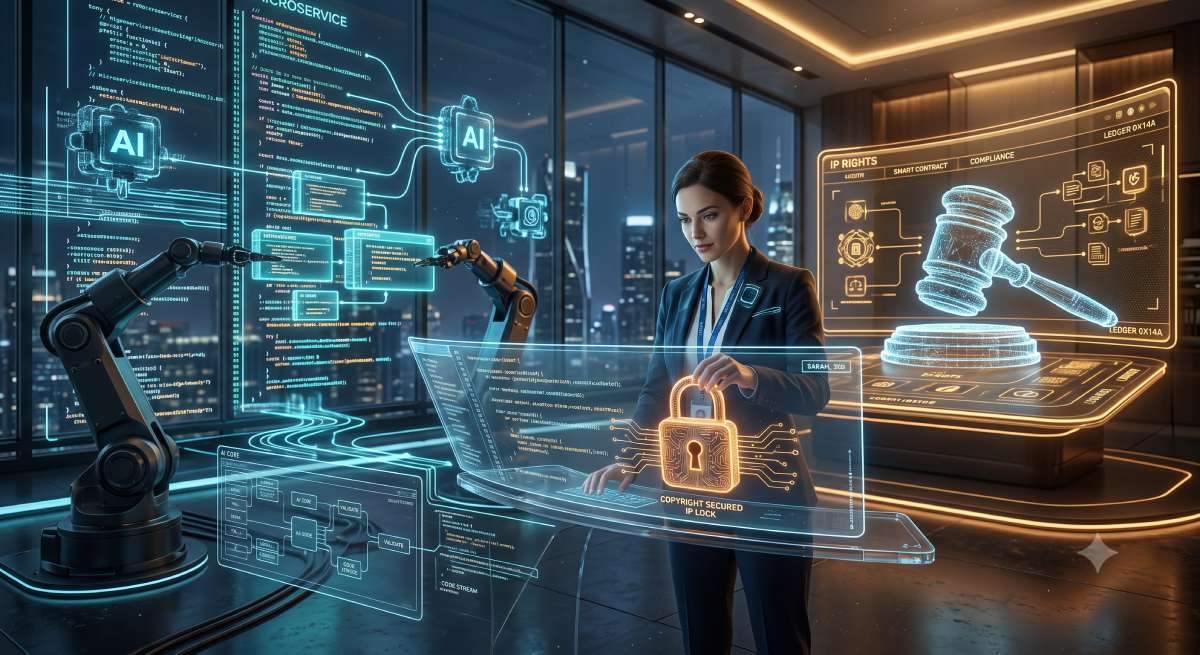
There was a time when a new developer joining an engineering team felt empowered simply by having access to Google Search, Stack Overflow, and official language documentation. Tracking down a cryptic syntax error or discovering a missing closing bracket after hours of debugging was considered a rite of passage. Today, the entry-level developer experience looks fundamentally different.
Engineering interns and fresh hires now step into their roles with instant access to state-of-the-art AI coding assistants—such as Claude, GitHub Copilot, and Amazon Q Developer—integrated directly into their IDEs from day one. Rather than spending days building boilerplate code or wrestling with foundational setup, the next generation of software engineers generates working code snippets in seconds. However, as AI takes over raw syntax generation, a critical question emerges: what is the future of developers who learned to write code strictly from scratch, and how does human expertise evolve in an AI-driven development lifecycle?
🚀 The Onboarding Shift: From Syntax Debugging to High-Level Abstraction
The speed at which new engineers contribute to production repositories has accelerated exponentially. In the past, early-career developers spent months internalizing basic language idiosyncrasies, memory management quirks, and framework-specific setups. Syntax errors, unclosed tags, and missing semicolons consumed a significant portion of an engineer's daily cognitive load.
AI coding engines have largely eliminated these initial friction points. Modern language models generate syntactically correct boilerplate, construct unit test suites, and write API integrations instantly. As a result, next-generation developers may never experience the traditional frustration of hunting down minor syntax typos. Instead, their entry point into software engineering begins at a much higher level of abstraction—focusing immediately on feature logic, architectural intent, and complex problem-solving.
🛡️ The Human Imperative: Security, Performance, and Best Practices
While AI assistants can generate functional code at incredible speed, generating code is not the same as engineering a secure, scalable software system. AI models synthesize patterns from vast training sets, which means they can inadvertently introduce security vulnerabilities, inefficient algorithmic complexity, or outdated dependencies if left unguided.
This reality redefines the primary responsibility of the modern software engineer. The job is shifting from manual line-by-line writing to rigorous code auditing, security verification, and performance optimization. Human intervention is essential across several critical areas:
- Security and Zero-Trust Guardrails: AI tools do not natively understand enterprise compliance requirements, internal access controls, or zero-trust architecture. Engineers must inspect generated code for SQL injection risks, insecure API endpoints, and memory leaks.
- Algorithmic Efficiency: A model might provide a working solution with an $O(n^2)$ time complexity when an $O(n \log n)$ approach is required for high-throughput production environments. Human expertise ensures optimal resource usage and minimal latency.
- Contextual Architecture: AI lacks deep domain awareness regarding long-term business strategy, cross-system dependencies, and legacy database structures. Engineers provide the strategic context that aligns code modules with broader system architecture.
🔄 Legacy Code Modernization: The AI-Assisted Transformation Journey
One of the most impactful applications of AI in modern software engineering is legacy system refactoring. Organizations across financial services, healthcare, and logistics maintain massive, mission-critical codebases written in legacy languages like COBOL, older Java frameworks, or monolithic PHP systems. Historically, refactoring these systems required years of manual translation, high execution risks, and immense capital expenditure.
Today, AI models act as translation engines, analyzing legacy logic, mapping dependencies, and proposing modernized microservices architectures in modern frameworks. However, successful modernization still depends entirely on human oversight. Engineers must validate business logic preservation, design robust regression testing pipelines, and ensure smooth data migration without disrupting live business operations. The combination of AI translation speed and human architectural guidance turns multi-year refactoring nightmares into structured, manageable engineering sprints.
⚖️ Scratch Coders vs. AI-Driven Engineers: What Does the Future Hold?
Will the future belong exclusively to AI-driven prompt engineers, or will "scratch coders" who understand low-level execution continue to thrive? The reality lies in a powerful hybrid model.
Developers who rely purely on manual syntax typing without leveraging AI tools will struggle to match the velocity expected in modern engineering environments. Conversely, developers who rely blindly on AI without understanding underlying computer science fundamentals—such as memory management, data structures, network protocols, and concurrency—will inevitably hit a wall when complex bugs, distributed system failures, or subtle security flaws occur.
The developers who will lead the industry are those who combine fundamental scratch-coding knowledge with AI orchestration skills. Knowing how code operates at a fundamental level allows an engineer to critique, refactor, and elevate AI-generated code far beyond its default output.
💡 Problem-Solving as the Ultimate Core Competency
Software development has never truly been about typing syntax; it has always been about solving problems. As syntax generation becomes commoditized, creative thinking, systems design, and domain expertise become an engineer's most valuable assets.
The evolution from manual coding to AI co-creation allows developers to focus their creative energy where it matters most: understanding human needs, designing resilient system architectures, and tackling grand engineering challenges. By adopting AI as a powerful force multiplier, developers can transform from syntax writers into true system architects, guiding digital intelligence toward safe, efficient, and transformative software solutions.