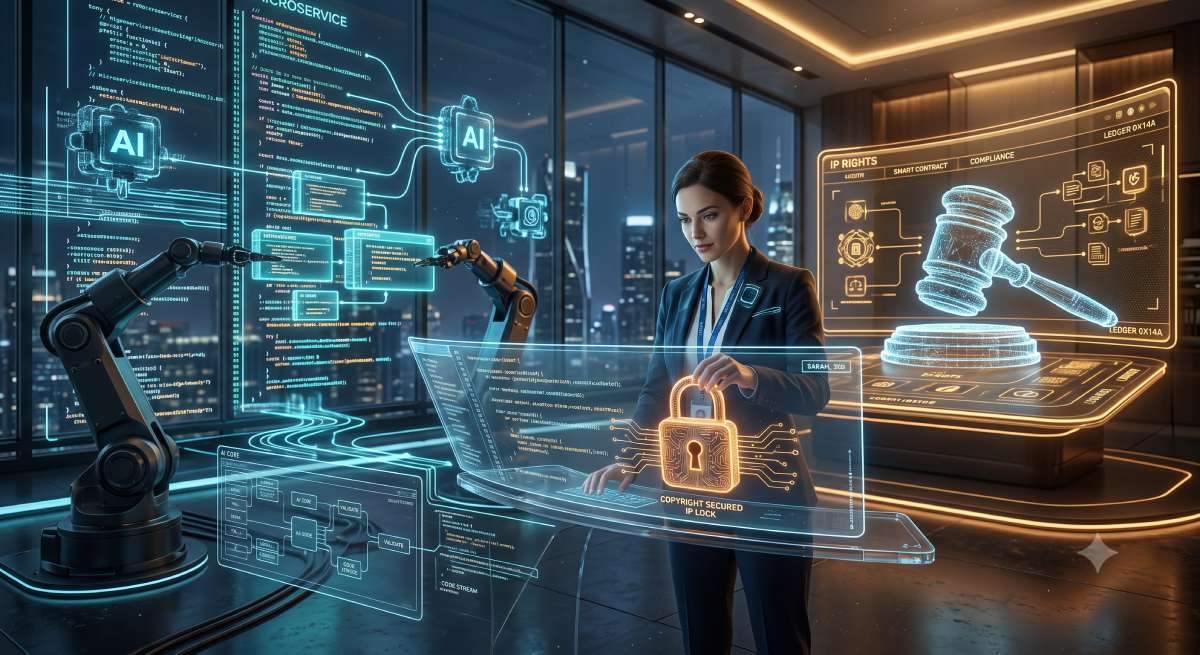
Software development has always evolved—from punch cards to IDEs, and from rigid waterfall monoliths to agile microservices. However, nothing has compressed that evolution quite like artificial intelligence in 2026. The days of writing every application from scratch, heavily relying on entirely manual processes, and struggling to maintain bloated monolithic architectures are rapidly fading. AI is no longer a mere experimental tool; it has become an essential collaborator, fundamentally reshaping every single stage of the software development life cycle (SDLC).
For organizations looking to modernize their legacy applications, this shift is monumental. In the past, modernization meant painstakingly refactoring thousands of lines of scratch code over a multi-year roadmap. Today, AI accelerates this execution by autonomously tracing dependencies, untangling legacy spaghetti code, and proposing scalable modern architectures. This is not just an incremental update; it is a structural transformation of the entire profession.
📋 From BRD to Deployment: The Agentic Workflow
Historically, gathering business requirements and translating them into a Business Requirement Document (BRD) was a highly manual, error-prone process. In 2026, AI helps teams analyze requirements with surgical accuracy using predictive analytics to identify potential bottlenecks early. Teams now use AI skills and autonomous agents that can literally interview stakeholders to ensure a crystal-clear definition of the problem and the intended solution before a single line of code is written.
Once requirements are gathered, architecture becomes the critical next step. As code generation becomes easier and faster, system design actually becomes more important, as it impacts every line of code written. When it comes to actual coding, we have moved entirely beyond simple autocomplete. One of the most interesting and dominant emerging patterns in 2026 is "spec-driven development". Rather than writing code directly, developers now write highly detailed specifications, and specialized digital agents implement them.
🛡️ Security and Testing: Is AI Just Testing AI?
With AI writing massive portions of the codebase, a critical question arises: is the resulting application secure, and who is actually testing it? The reality is that secure coding practices are now integrated directly into AI-powered workflows. Intelligent systems scan code automatically, highlighting security risks during development rather than waiting for post-deployment vulnerability scans.
However, heavily relying on AI introduces what the industry calls the "Nondeterminism Problem". Traditional software outputs were deterministic, but generative components can produce wildly different results from the exact same input. Furthermore, global regulatory frameworks are demanding stricter oversight. For example, under the EU AI Act, transparency obligations applicable from August 2, 2026, require the marking and detection of AI-generated content. Therefore, human oversight remains non-negotiable. Humans still own the final approval, define the quality standards, manage risk tolerance, and make the final release judgments.
⚖️ The Legal Minefield: Who Actually Owns the Code?
As we transition entirely to AI-driven development, the most complex barrier isn't technical—it is legal. If an AI generates your modernized application, who holds the intellectual property (IP) rights? In standard software development, ownership is easily addressed in an employment contract. With AI, the legal reality in 2026 is significantly more complicated.
The fundamental rule currently upheld globally is that code created without substantial human creative input may not be legally protected by copyright. In 2026, the U.S. Supreme Court's denial of certiorari in Thaler v. Perlmutter cemented the rule that only human beings can hold copyright authorship. The U.S. Copyright Office (USCO) has also explicitly stated that merely entering prompts into a generative AI tool does not make the user an author of the output. Similarly, under current Indian copyright law, purely AI-generated content without meaningful human input is unlikely to qualify for copyright protection.
For businesses modernizing their apps, this introduces massive risk. Works that cannot qualify for copyright include output generated solely by prompts—no matter how detailed or creative the prompts themselves may be. AI-assisted works can only be copyrighted if the human contribution is sufficiently creative and controls the expressive elements of the final work.
To protect their intellectual property, engineering teams and businesses must completely change how they document their development process. In 2026, legal experts strongly advise that creators save every iteration, including raw AI outputs and intermediate edits, because the Copyright Office wants to see the specific human-authored layer. Furthermore, developers must save the exact prompt text to help establish the boundary between AI output and human edits. Modernization in the AI era guarantees unprecedented speed, but true ownership strictly belongs to the humans who build the guardrails, document their iterations, and actively shape the final architecture.
❓ Frequently Asked Questions
Can I copyright code generated entirely by an AI?
No. In most jurisdictions, copyright law requires human authorship. The legal precedent in 2026 confirms that only human beings can hold copyright authorship, meaning works created entirely by a machine generally fall into the public domain.
Does writing a highly detailed prompt grant me copyright ownership over the AI's output?
No. Copyright offices have explicitly stated that merely entering prompts into a generative AI tool does not make the user an author of the output. Output generated solely by prompts cannot qualify for copyright protection, regardless of how creative or complex the prompts are.
Frequently Asked Questions
📋 From BRD to Deployment: The Agentic Workflow Historically, gathering business requirements and translating them into a Business Requirement Document (BRD) was a highly manual, error-prone process. In 2026, AI helps teams analyze requirements with surgical accuracy using predictive analytics to identify potential bottlenecks early. Teams now use AI skills and autonomous agents that can literally interview stakeholders to ensure a crystal-clear definition of the problem and the intended solution before a single line of code is written. Once requirements are gathered, architecture becomes the critical next step. As code generation becomes easier and faster, system design actually becomes more important, as it impacts every line of code written. When it comes to actual coding, we have moved entirely beyond simple autocomplete. One of the most interesting and dominant emerging patterns in 2026 is "spec-driven development". Rather than writing code directly, developers now write highly detailed specifications, and specialized digital agents implement them. 🛡️ Security and Testing: Is AI Just Testing AI?
With AI writing massive portions of the codebase, a critical question arises: is the resulting application secure, and who is actually testing it? The reality is that secure coding practices are now integrated directly into AI-powered workflows. Intelligent systems scan code automatically, highlighting security risks during development rather than waiting for post-deployment vulnerability scans. However, heavily relying on AI introduces what the industry calls the "Nondeterminism Problem".…
⚖️ The Legal Minefield: Who Actually Owns the Code?
As we transition entirely to AI-driven development, the most complex barrier isn't technical—it is legal. If an AI generates your modernized application, who holds the intellectual property (IP) rights? In standard software development, ownership is easily addressed in an employment contract. With AI, the legal reality in 2026 is significantly more complicated. The fundamental rule currently upheld globally is that code created without substantial human creative input may not be legally pr…
❓ Frequently Asked Questions Can I copyright code generated entirely by an AI?
No. In most jurisdictions, copyright law requires human authorship. The legal precedent in 2026 confirms that only human beings can hold copyright authorship, meaning works created entirely by a machine generally fall into the public domain.
Does writing a highly detailed prompt grant me copyright ownership over the AI's output?
No. Copyright offices have explicitly stated that merely entering prompts into a generative AI tool does not make the user an author of the output. Output generated solely by prompts cannot qualify for copyright protection, regardless of how creative or complex the prompts are.
Disclaimer: This article is for educational and informational purposes only and does not constitute financial, investment, or tax advice. Please consult a qualified financial advisor before making any investment decisions. Past performance is not indicative of future results.